



johndoe@gmail.com

by Jack Solloway
On humor, satire, and wit in visual art
Is art a laughing matter? From righteous laughter to a wry smile, we look at depictions of amusement alongside our own instinct to laugh at visual art this April Fools' Day.
Discover free-to-read chapters featured from across the Bloomsbury Visual Arts hub, including the new Theory of Art and Art History and Visual Culture Reference collections.
Cracking up
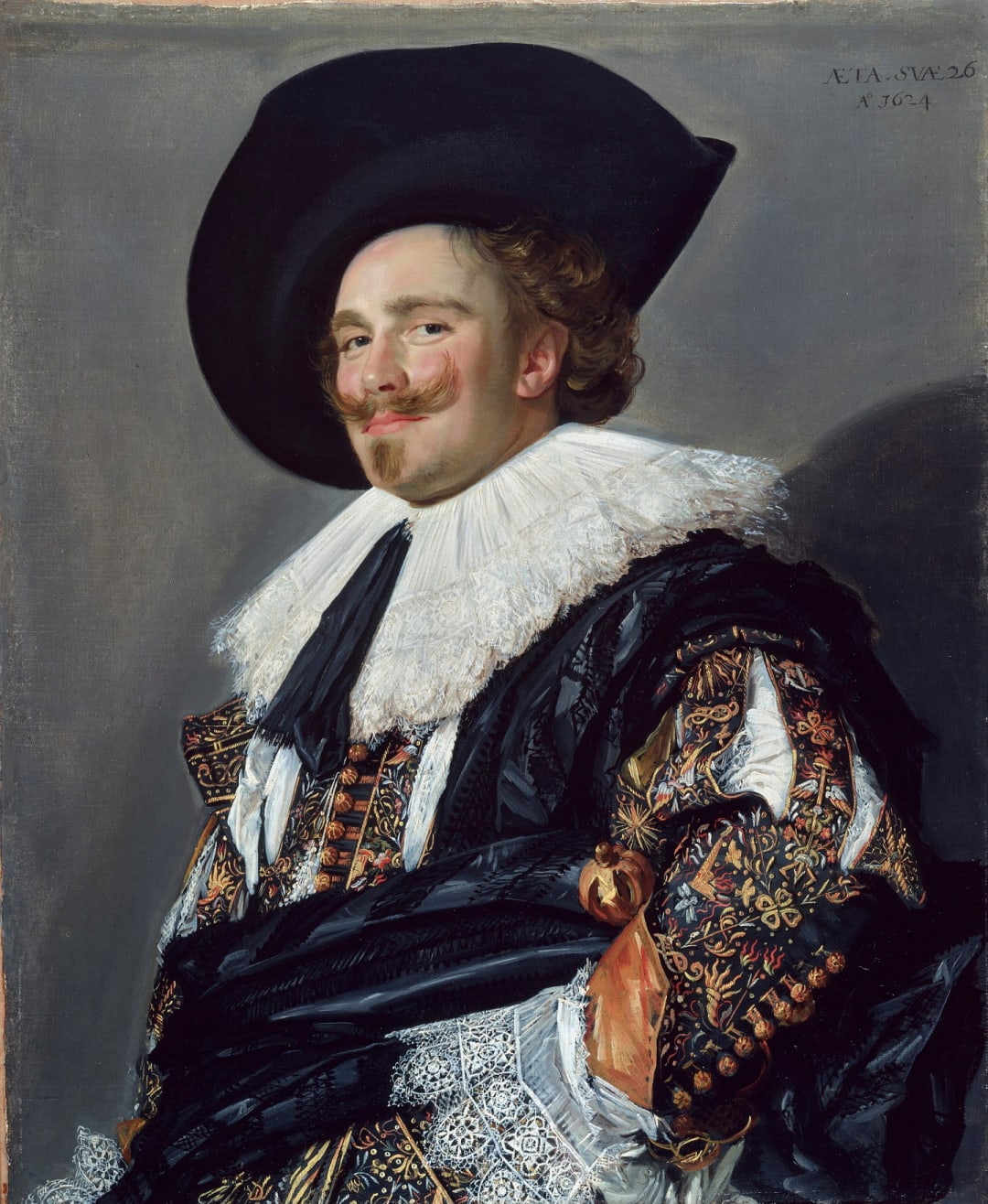
Laughter lines, also known as smile lines, are facial wrinkles closely associated with expressions of joy and pleasure. It’s perhaps odd, then, that the sitter in Frans Hals's Laughing Cavalier (1624), arguably the most famous portrayal of amusement, barely cracks a smile.
Instead, Hals's portrait betrays more through costume what the sitter lets slip with a wry and knowing look. A twinkle of the eye, the slight curl in his moustache – his emotion is subtle yet unmistakable. “He is a groom portrayed on his wedding day”, writes Lilian H. Zirpolo in the Historical Dictionary of Baroque Art and Architecture. You can read her entry for the full story.
"The smile in art is not a typical gesture", but it is an enduring one. This is Sheri Klein's assessment in her book Art and Laughter, which examines how artists use this gesture throughout history – from cracking a smile to cracking up with laughter. Read Klein's chapter surveying "Smiling Portraits in Art" for the full story.
Joking in good faith
Was it kosher to giggle about God in the Middle Ages? "Satire: Sacred and Profane" by Anne L. Williams dispels a few misconceptions about medieval religious art.
Like the paintings she writes about, Williams "discredit[s] entirely the traditional partitioning of ‘low' profane humor from ‘high' veneration and theology". Her book Satire, Veneration, and St. Joseph in Art, c. 1300-1550 explores how satirical art might strengthen veneration by proving its robustness against caricature.
Williams draws on Mikal Bakhtin's theory of the carnivalesque. She invites us to consider how periods of carnival and the upending of social hierarchies, through comedy, spectacle, and play, actually serve to reinforce the status quo. (For more a contemporary account of carnival, read Robert Stam on "Carnival, Radical Humor, and Media Politics".)
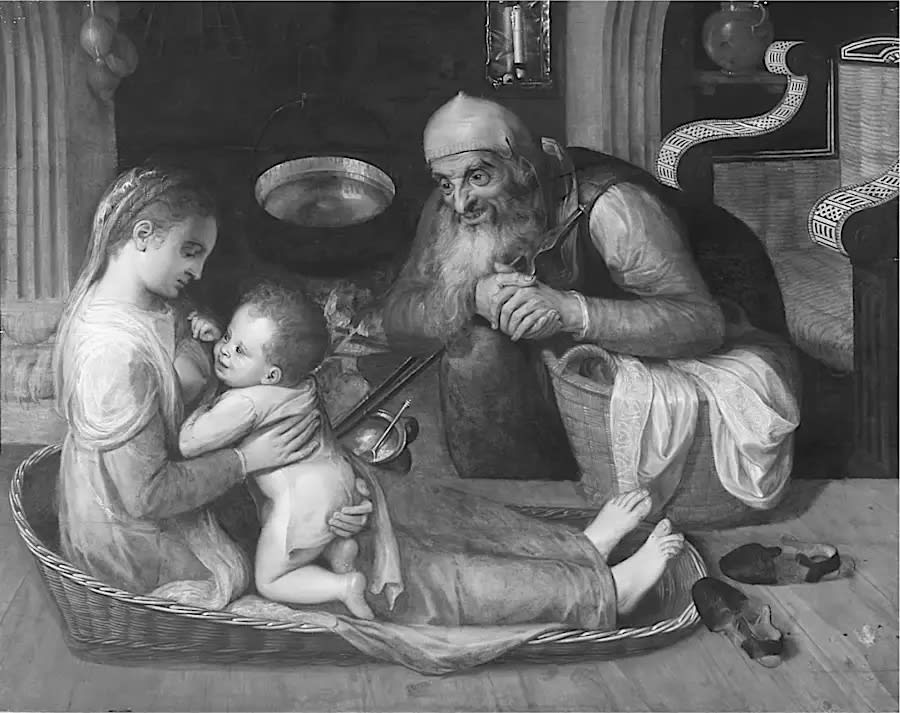
Frans Floris's Holy Family, 1553–1554 is a great example of this. The painting sends up St. Joseph's absurd predicament. He may be "Christ's foster-father", as Williams puts it, but he still has to do the laundry and cook the porridge. Floris's depiction of a beset house-husband returns us to the domestic reality upended by miracle and revelation. Joseph is believably – haggardly – just like us.
This is only a provocation if we take seriously, as Floris does, the Nativity in all its absurdity. Miracles are worth revering because they are absurd. Floris's painting puts this into practice.
From the sublime to the ridiculous…
…there is only a step. Napoleon Bonaparte supposedly thought so. "Du sublime au ridicule il n'y a qu'un pas", he remarked in 1812 after his defeat in Russia, according to Napoleon's former secretary, Dominique-Georges-Frédéric Dufour de Pradt.
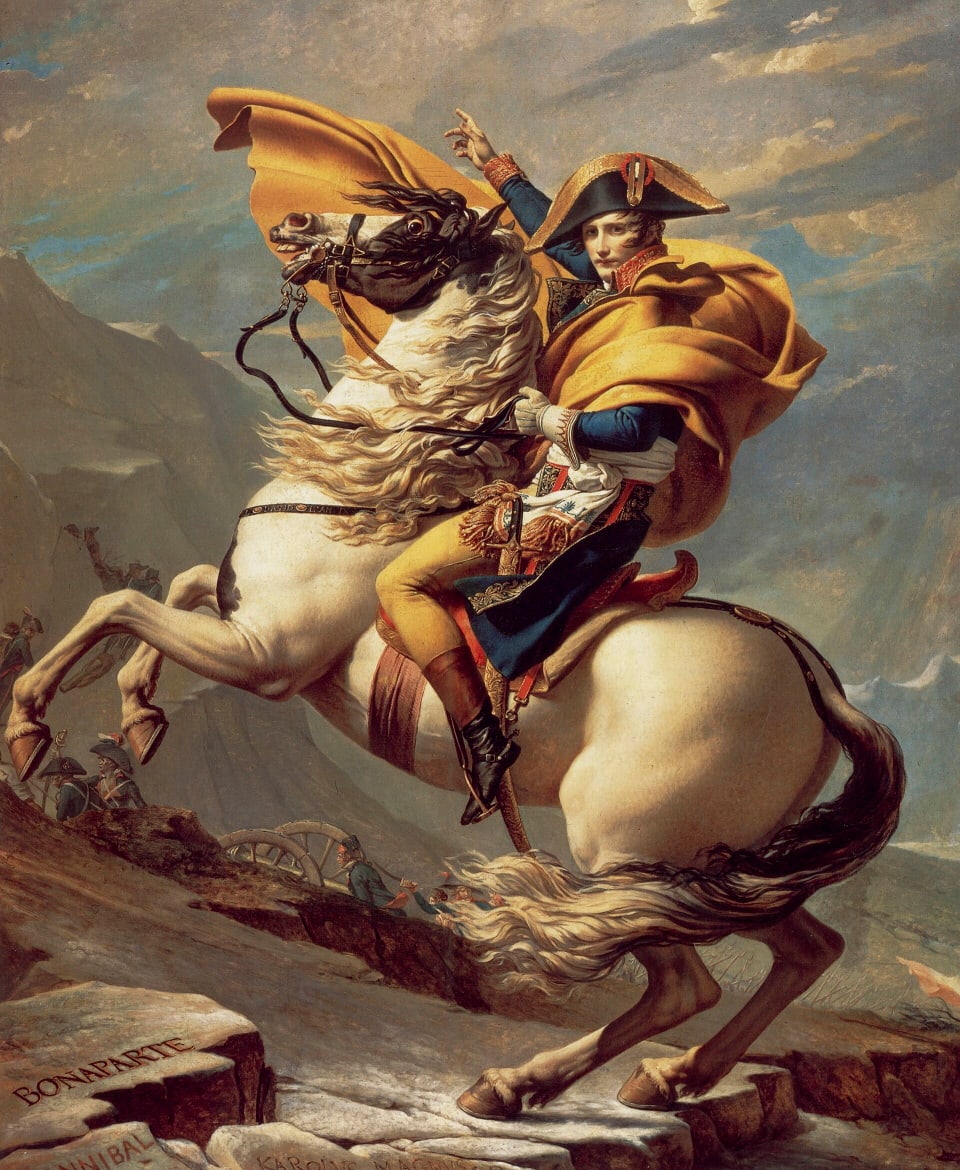
Most attempts at sublimity teeter into ridicule. What do we make, then, of Jacques-Louis David's famous painting Napoleon Crossing the Alps? David made five versions of his famous painting, the first in 1801, a year after Napoleon's crossing in May 1800. "In his actual crossing", reads Catherine A. Moore and Megan Hauser's introduction to Political Illustration, "Napoleon rode a mule instead of a horse, and he didn't lead his troops but followed a few days after". They also note Napoleon's diminutive stature ("reportedly 5'6" tall, average for the time, and ‘so thin as to have a sickly air'") and the pleasantness of the weather, neither which make it into David's painting.
If this contradiction, between Napoleon's public persona and the less than flattering reality of his crossing, seems risible, the humor we find in it fails to account for the success Napoleon found in projecting this image as part of his propaganda.
For the full story and Napoleon's response to being painted, read Moore and Hauser's introductory chapter on "Propaganda: Art and the State".
Pomp without circumstance
Thomas Paine wrote in 1793 during the French Revolution that "one step above the sublime, makes the ridiculous; and one step above the ridiculous, makes the sublime again". This strange escalation, an Escher-like paradox of climbing from high to low (not the other way around), describes sublimity and ridiculousness as transcending and usurping one another, while also creating the conditions for their alternating rise and fall.
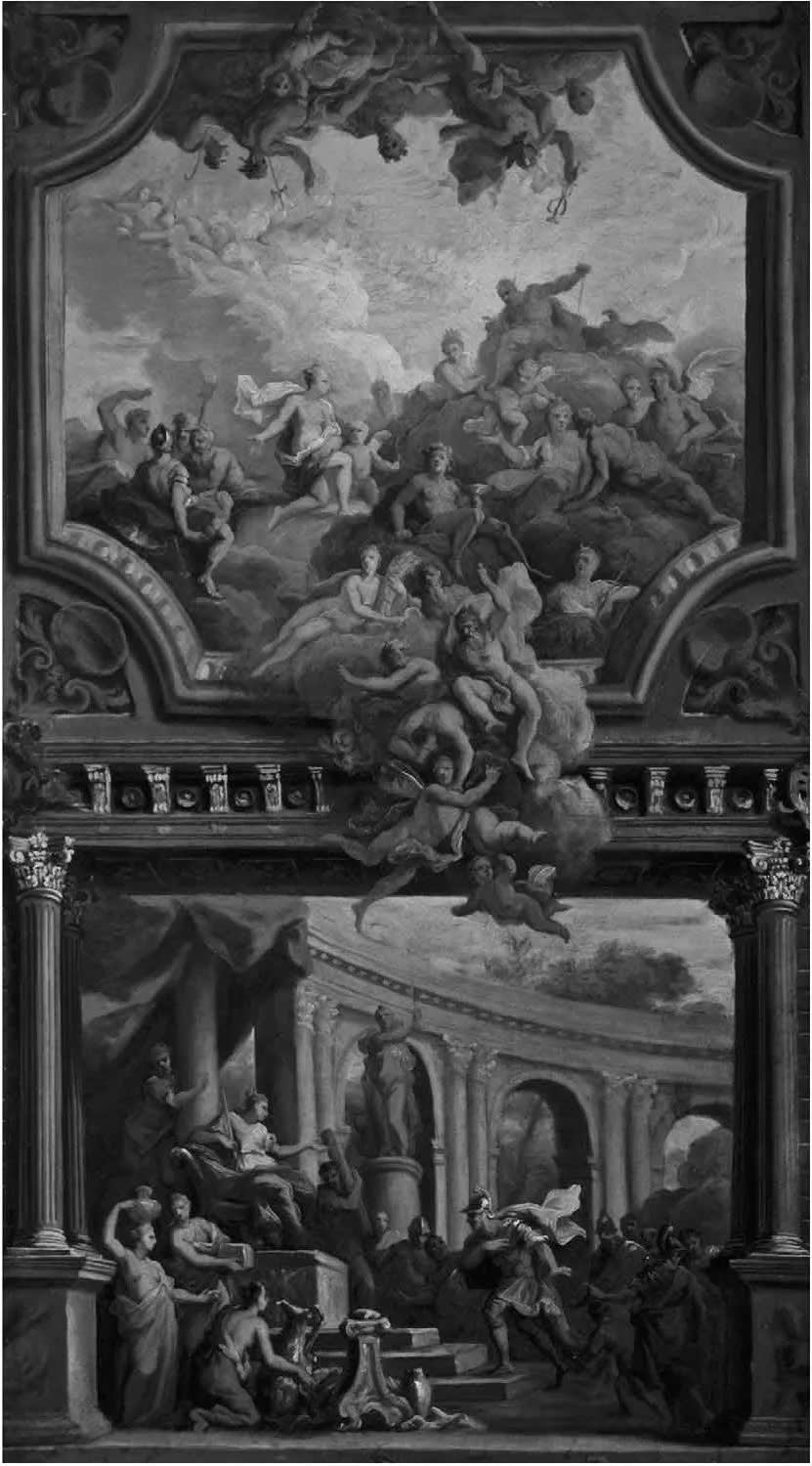
This is a good description of what comedy does, which, as we've seen with Bakhtin's carnivalesque, relies on social revolutions. Comedic art heightens and subverts, elevates and collapses. The early 18th-century poet Alexander Pope, as Lydia Hamlett writes in "Poetry, Painting and Politics", "was especially sceptical of political showiness through materialism and it was he who coined the word ‘bathos' as sublimity's opposite".
Pope lampooned Whiggish fashions, Hamlett explains, for baroque architecture, preferring instead the Greco-Roman neo-classical style, quoting his poem "An Epistle to the Right Honourable Richard Earl of Burlington, London 1731": "Rome was glorious, not profuse, / And pompous Buildings once were things of use".
Their taste for useless and excessive ornament – pomp without circumstance, in other words – was, for Pope, not only indicative of their architecture but their politics. The criticism is therefore satirical in its aesthetic critique of how visual art becomes a symbol for political leanings.
For more on humor and architecture, read Susanna Pasquali's chapter "Laughing at the Baroque" from Laughing at Architecture: Architectural Histories of Humour, Satire and Wit.
Content linked to in this blog will be free for three months after the post date.
For full access to our cross-searchable collections on the Bloomsbury Visual Arts hub, visit our Librarians page for information on trials and purchasing.
Explore the News and Updates page for the latest launches and collection updates.
